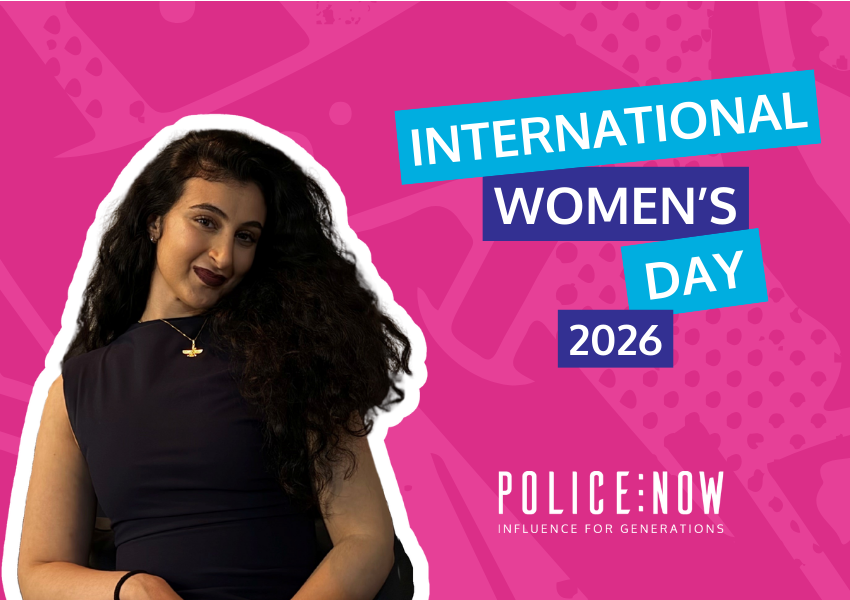
Tara Shahsavar is the first woman in her family to join policing – defying expectation and surprising her family with the decision.
A Middle Eastern woman and law undergraduate, her parents expected her to become a lawyer.
But Tara wanted to prevent crime before it could get to the courtroom, be a role model for others in the community, and carve her own path.
This International Women’s Day, she tells us how she discovered her inner strength and why she encourages other women to join the frontline.
Were you nervous about joining policing as a woman?
“I was nervous, because I would be doing something that wasn’t expected of me or typical for women in my culture. But that’s partly what motivated me; I’d never met a Persian policewoman before, and I wanted to be a familiar face in the community to help bridge that gap.
“When I told my family I was joining Police Now’s programme, their jaws were on the floor. But I didn’t want to hold myself back. I felt like neighbourhood policing was somewhere I could really make a difference, and that it might actually be my calling.
“Now, my parents are so supportive. They’ve seen the value of the role and how happy it makes me. They saw me give a speech after completing my initial training, and heard senior leaders say that I have so much potential; they told my parents ‘There’s a reason your daughter’s here.’ My mum now proudly tells everyone, ‘My daughter is a police officer,’ and my dad says the job fits my energy and drive.”
What are some of the other challenges you have faced as a woman in policing?
“Frontline policing is already a demanding career, and I additionally face inappropriate and offensive comments from the public just for being a woman.
“The comments are very frustrating, but they’re also what have taught me the most about resilience, strength, and myself. Seeing what I’m capable of in these situations and learning that I can hold my own, despite the challenge, has given me a huge sense of pride and accomplishment. I have grown so much as a person, which is incredibly rewarding. I don’t think I’d get that in many other careers.”
How do you manage some of these challenges?
“There is a lot of support available in policing; you’re not on your own.
“I’m part of the Women in Policing Network and the Black and Asian Policing Association, and I’ve met the most inspiring role models and leaders there. They’ve opened doors so our merits are recognised and paved the way for people like me, and I want to do the same for others.
“Police Now also provides unparalleled support. They don’t just throw you into the thick of it without help, they go above and beyond to help and understand you. They’ve supported me as a woman in policing but also with things like my neurodivergence. My Personal Development Coach has been invaluable; she always advocates for me, she’s there when I just need to talk, and she’s there to help me form a plan when I want to act.”
Were you nervous about your safety?
“At first, yes, I worried how I’d defend myself or handcuff someone twice my size.
“But you’re properly trained, and we all work together and keep each other safe. Now, it feels like second nature when I have to arrest someone. It all comes with practice, technique, and time.
“You’d also be surprised by how much strength, power and presence you have. Most situations are resolved or de-escalated through good communication, not physical strength or size, and women are often brilliant communicators.”
What would you say to other women thinking about joining policing?
“Don’t let your gender, your culture, or your doubts hold you back. Don’t let nerves or a perceived lack of confidence prevent you from taking this step. You’ll be surprised how quickly your confidence and skills grow. It’s a journey, and you’ll keep progressing – you just have to take the first step and carve the life that is right for you.
“For me, just putting the uniform on for the first time gave me a whole new sense of confidence and purpose. I saw this with others on Police Now’s programme too; people coming out of their shells and starting to feel like they can achieve anything – and they can. Women shouldn’t limit ourselves because of the idea that we don’t belong somewhere. We do belong, and in policing we have amazing colleagues to support us.”
– Police Constable Tara Shahsavar, West Midlands Police